
Jasper AI: The Pros, the Cons, and the Right Use Cases
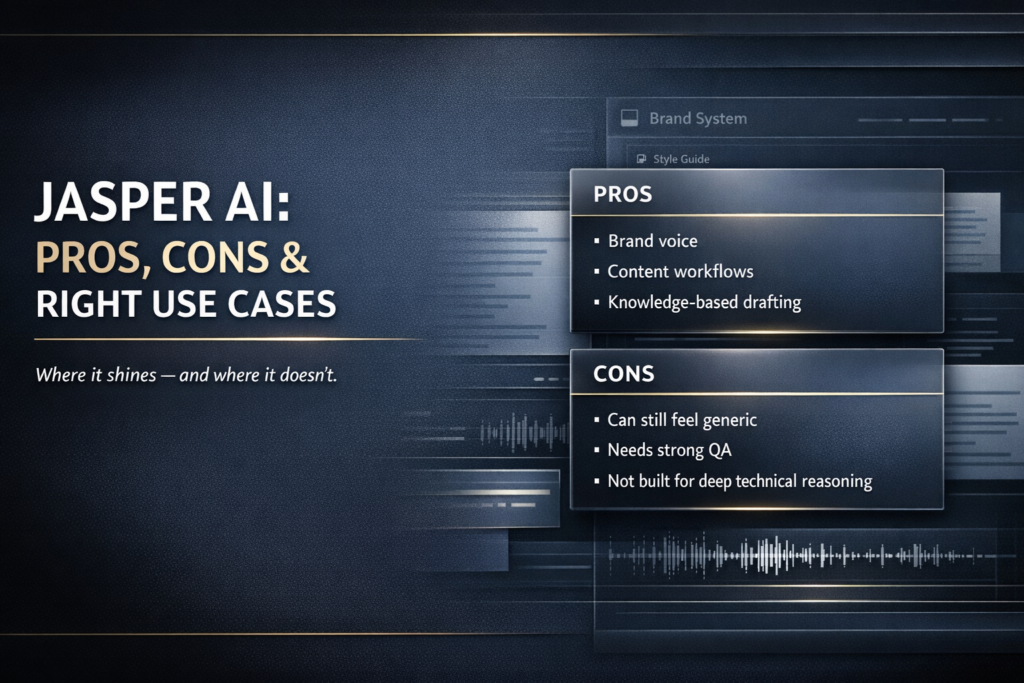
Jasper is one of the clearest examples of an AI platform designed for marketing operations, not just casual prompting.
Its strengths are obvious. Jasper’s Brand Voice feature lets teams build a voice from text, files, or URLs, and its Knowledge Base lets teams upload reusable business context, product details, white papers, and other source material. On Business plans, teams can also use Style Guide rules and manage private or workspace-level brand assets. That is a meaningful advantage when multiple people need content that sounds consistent.
That is the upside: Jasper can help turn scattered prompting into a more structured content system.
The downside is that structure alone does not guarantee quality. If the voice examples are weak, the source material is thin, or the review process is loose, AI content can still come out flat, generic, or over-polished. In other words, Jasper can improve consistency — but it does not replace editorial judgment.
Another limitation is that Jasper is not really trying to be your strongest technical reasoning engine. It is optimized for marketing workflows, not for advanced coding or system architecture. If a team needs deep technical reasoning, integration thinking, or developer support, a different tool may be stronger for that layer of work.
So who should use Jasper?
Jasper makes sense for:
- teams producing recurring marketing content
- brands that care about tone consistency
- organizations that want reusable voice and knowledge layers
- marketing operations that need more structure than raw prompting
Jasper is a weaker fit when the core challenge is technical architecture, automation logic, or code-heavy workflows.
The smartest way to use Jasper is not as a miracle copy machine. It is as a governed content layer inside a human-led workflow.